
Figures checked November 10, 2026.
I like a simple question. It keeps everybody honest.
Over the last five years, how did gold and silver do against the stock market? And while we’re at it, where is most of the money in the S&P 500 actually parked? Is it AI?
People in my shop ask versions of those questions all the time. So I looked up the numbers, from sources you can check yourself.
The scoreboard
From mid-November 2021 to this week, both gold and silver more than doubled. The S&P 500, measured by price alone, was up about 62 percent. That’s a solid run for stocks. The metals simply did better over this particular stretch.
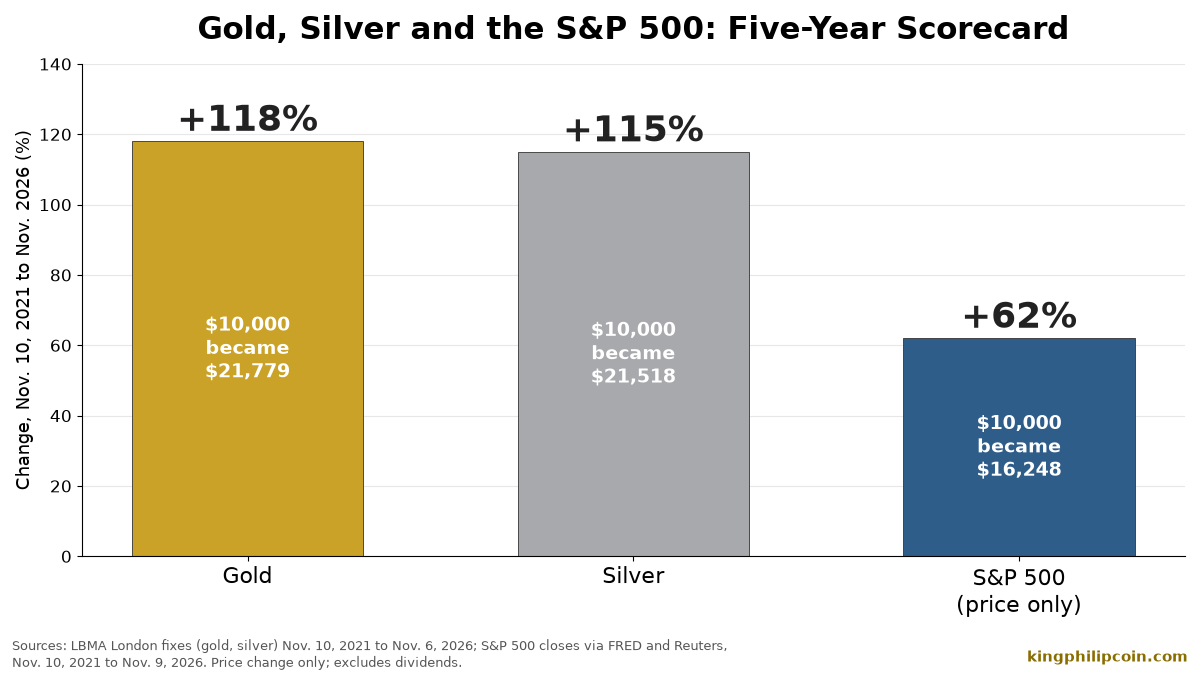
| Asset | Starting point | Recent level | Change |
|---|---|---|---|
| Gold (London PM fix) | $1,859.40 on Nov. 10, 2021 | $4,049.60 on Nov. 6, 2026 | +118% |
| Silver (London fix) | $24.175 on Nov. 10, 2021 | $52.02 on Nov. 6, 2026 | +115% |
| S&P 500 (price only) | 4,646.71 on Nov. 10, 2021 | 7,549.94 on Nov. 9, 2026 | +62% |
| Nasdaq-100 (for context) | 15,985.57 on Nov. 10, 2021 | 27,907.63 on Nov. 9, 2026 | +75% |
| Platinum (COMEX, for context) | $1,075.80 on Nov. 10, 2021 | $1,561.20 on Nov. 9, 2026 | +45% |
The gold and silver starting prices are the official LBMA London benchmarks for November 10, 2021, as recorded in contemporary price archives and a KGHM market bulletin from that date. The latest London fixes I could independently confirm are the November 6, 2026 afternoon prices of $4,049.60 for gold and $52.02 for silver.
Stock figures are official closing levels. The S&P 500’s November 10, 2021 close of 4,646.71 is from the Federal Reserve Bank of St. Louis. On November 9, 2026, the index closed at 7,549.94, as Reuters reported. The Nasdaq-100 comparison uses the same dates from the Fed’s Nasdaq-100 series.
On the morning of November 10, 2026, Kitco spot quotes were near $4,048 for gold and $51.88 for silver. On the same dates as the stock closes, COMEX gold futures went from $1,848.30 on November 10, 2021, to $4,114.50 on November 9, 2026, about 123 percent. Silver futures went from $24.77 to $52.56, about 112 percent. Different yardsticks, same story.
What the difference actually means
A couple of honest footnotes belong on that scoreboard.
Stocks pay dividends. Gold and silver do not. If you reinvested S&P 500 dividends, you did better than the 62 percent price gain. State Street’s data for the S&P 500 index, the benchmark behind the SPY fund, show a total return of 12.06 percent a year over the five years ended October 31, 2026. That works out to about 77 percent in all, still short of what gold and silver did on price alone over nearly the same period.
Silver also had a bumpier ride. It reached much higher prices earlier in 2026, then gave a good deal of that back. The five-year result is still a more than doubling, but a good long stretch is not the same as a smooth one. Gold was steadier, which is usually how these two metals behave.
None of this is a promise about the next five years. Markets have a habit of humbling people who talk that way. I have been in this business since 1976, and I have watched plenty of sure things change their minds.
So where is the S&P money parked? Is it AI?
In a word, a lot of it is.
The S&P 500 is supposed to be a broad slice of American business. In practice, a small group of giant companies now carries a large share of the index. That is how a market-cap-weighted index works: the bigger a company gets, the more of your “index fund” dollar goes there.
As of November 9, 2026, State Street’s official S&P 500 holdings showed:
- Apple, 7.87 percent of the index
- Nvidia, 6.64 percent
- Microsoft, 6.22 percent
- Amazon, 4.03 percent
- Alphabet (both share classes combined), 4.69 percent
- Broadcom, 2.34 percent
- Meta, 2.17 percent
Most of those names sit at the center of the technology and artificial-intelligence trade. Apple, Nvidia, Microsoft, Amazon, Alphabet and Meta alone were 31.6 percent of the index. The ten largest individual holdings, counting Alphabet’s two share classes separately, added up to 37.4 percent. Information technology was 36.1 percent of the index, and communication services, home to Alphabet and Meta, was another 8.8 percent. Add those two sectors and you are close to 45 percent of the S&P 500.
Tesla, often grouped with those companies as part of the “Magnificent Seven,” was not among the ten largest holdings on that date. Eli Lilly and Berkshire Hathaway were. There isn’t a single official scoreboard for how much of the five-year S&P 500 gain came from the AI-related names alone. The weights, though, are plain enough: a large share of “the market” is now a concentrated bet on a handful of very large technology companies.
That can work out well when those companies are doing well. It also means an S&P 500 index fund is less of a broad sampler than many people think. You don’t have to be bearish on AI to notice that a lot of eggs are in a few baskets.
What I take from it
I don’t tell people to abandon stocks, and I don’t tell them gold and silver will always come in first. I do tell them it is useful to own more than one kind of value.
Gold and silver are not a company, and they are not a software story. They do not pay a dividend, and their prices move. What they offer is something different: real metal you can hold, not tied to any one firm’s earnings or to the handful of names now carrying so much of the stock index. Over the last five years, that simple difference also happened to be a good financial one.
If you want to add some gold, silver or platinum, I can help you do it in a straightforward way. Florida buyers pay no sales tax on bullion, at any purchase amount. You can buy in person at my Southpoint office with cash, check or a trade, or order for insured shipping, which is free on orders over $5,000. Start here: Buy gold, silver and platinum in Jacksonville.
This article is general information, not financial advice. Past performance is not a guarantee of future results. Prices move every day, and the figures here are as of the dates shown.