On Wednesday in Shenzhen, two presidents talked as if the world’s center of gravity had already moved. I was not in the room. I read the official readouts, and then I read how the papers translated them, which is not always the same job.
Chinese President Xi Jinping met Russian President Vladimir Putin on November 18, 2026, on the sidelines of the Asia-Pacific Economic Cooperation summit. China’s Foreign Ministry, in its official English account of the talks, said the two sides should “firmly shoulder the due responsibilities of major countries, and spearhead efforts for building a multipolar world and promoting greater democracy in international relations.” Xinhua, the state news agency, put the same idea as “guide and promote.” China Daily wrote that Xi called on the two countries to “take the lead in advancing a multipolar world.”
Putin, speaking later that day at the APEC CEO Summit, was blunter. In the Kremlin’s official English transcript, he said “the former hegemonic powers” were trying to “hold back those who are achieving success and making progress.” He went on, “Experience has shown that the old instruments of economic domination and de facto coercion have become obsolete and have largely lost their power to intimidate. Sanctions, tariffs and export restrictions may still have a restraining effect, but they are no longer capable of bringing growth to a complete halt, let alone crushing the economies of competitors.” On Europe, he said budget deficits, debt, and inflation were placing “a heavy burden on European businesses and citizens, whose living standards are steadily declining — a particularly humiliating development for the Eurozone.”
How the papers told it
Western wires tightened that last line. Reuters, Al Jazeera, and The Guardian wrote that Putin called Western powers “former hegemons” and said Europe was in a “humiliating decline.” That is the same speech, boiled down. The official wording was about living standards in the eurozone, not a funeral oration for the whole continent. I point that out because the difference between a transcript and a headline is where a lot of heat gets made.
TASS, Russia’s state news agency, played the remarks as a straight statement about “former hegemonies” and Europe’s budgets, debt, and inflation. Chinese official accounts stayed smoother: stability, certainty, a “new type of major-country relations,” and a fairer order. The South China Morning Post, in Hong Kong, led with the pledge to seek a “fairer global order” ahead of a three-way meeting with the American president. Nikkei Asia‘s headline was sharper: “Xi, Putin vow to lead multipolar world, slam protectionism.”
Not everyone in the hall bought the sanctions talk. Canada’s prime minister, Mark Carney, told reporters Putin was “lying.” “Sanctions are very real and they’re going to continue to increase as long as this war goes on,” he said, according to The Guardian. Russia invaded Ukraine in February 2022, and that war is still being fought. I will not pretend a speech in Shenzhen settled it, and I will not treat Putin’s upbeat claims about the Russian economy as numbers I have audited from here.
This is a season, not a single afternoon
Now, I don’t take a speech as a prophecy, and I don’t take a cycle as fate. But the pattern is older than any one summit. Historian Neil Howe, who wrote The Fourth Turning with the late William Strauss, says modern history moves in long seasons of about eighty to one hundred years, each cut into four shorter “turnings.” He dates the current Crisis era from the financial shock of 2008. In a July 19, 2023 interview, he put it plainly: “remember, the crisis is not an event, it’s an era, right? It’s a whole generation long period of time.”
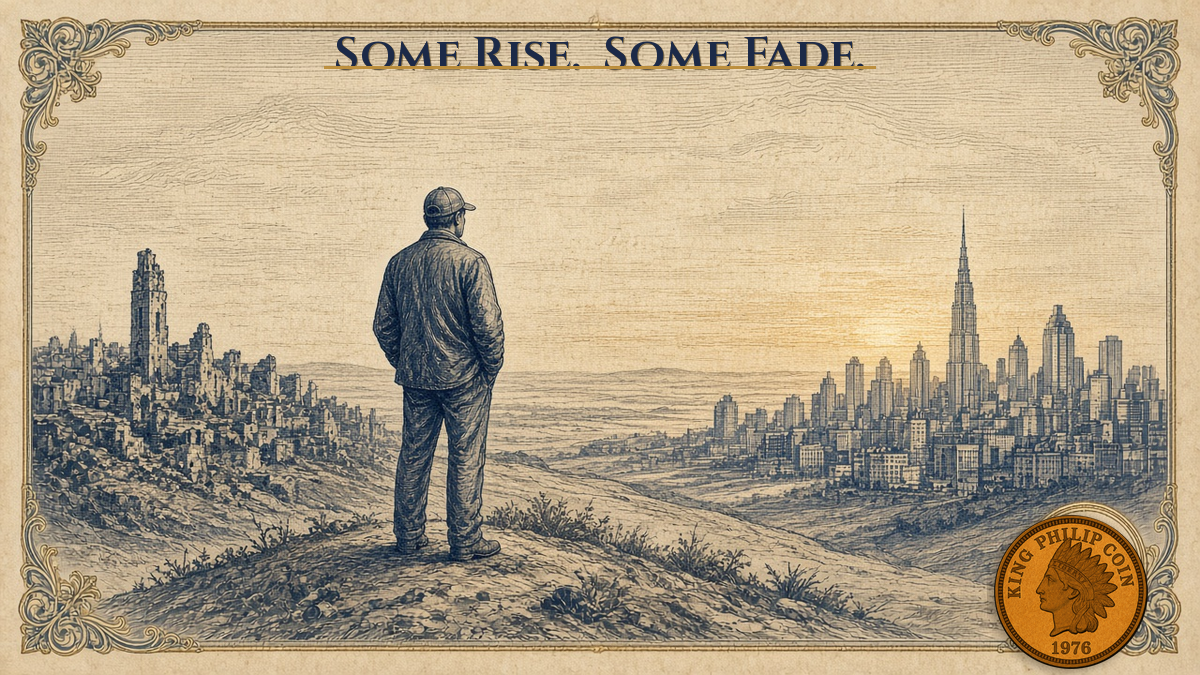
In a season like that, some countries rise and some lose altitude. The talks in Shenzhen were one more public argument about who gets to write the next set of rules. Howe looks toward a climax window around the end of this decade into the early 2030s. The official Simon & Schuster page for his 2023 book, The Fourth Turning Is Here, says present unrest “will culminate by the early 2030s in a climax that poses great danger and yet also holds great promise.” Asked in that 2023 interview whether it was “on schedule for around 2030,” he said, “Yeah. Something like that,” then caught himself: he was “predicting tides here. We’re not predicting when the individual waves are gonna break.” A band of dates, not a promise you can take to the bank. His next book, How to Prepare for the End of the World (As We Know It)/Neil-Howe/9781668210741), is due from Simon & Schuster on March 16, 2027. The title is grim. The useful part, if the earlier books are a guide, is the preparation, not the guessing.
What decline looks like when it comes home
The part that matters in Jacksonville is not who won the podium. It’s what happens inside a country that is losing confidence in its money, its debts, or its own arrangements.
Rome did not fall in an afternoon. It debased the silver denarius, again and again, until much of the “silver” coinage of the third century was copper with a wash of precious metal. People quietly held onto the older, better coins. Spain, in the age of Philip II, owned the great silver mountain at Potosí and still suspended payments to its bankers in 1557, 1560, 1575, and 1596, as the economists Mauricio Drelichman and Hans-Joachim Voth have documented. The metal came in, and it went out again to pay for wars. After its golden age, the Dutch Republic watched London take the lead in trade and finance. Britain, after the Second World War, devalued the pound from $4.03 to $2.80 in 1949, and again from $2.80 to $2.40 in 1967. For decades it also kept tight exchange controls, including on gold in private hands. That is a habit of a currency under strain: first the debasement or the devaluation, then rules about what ordinary people are allowed to buy, hold, or take across a border.
When confidence really cracks, the kitchen feels it first. In Germany in 1923, paper marks lost their meaning so fast that a loaf of bread was priced in the hundreds of billions. In 1991 the Soviet Union was dissolved; in 1992 Russian prices exploded, and ordinary ruble savings lost most of what they could buy. In Argentina in December 2001, the government froze bank withdrawals in the episode still called the corralito. People who had only a number in a bank found that number harder to reach. People who had something real outside the system at least had a choice.
I am not saying Europe, or America, is 1923, or 1991, or 2001. A speech is not a balance sheet. Eurostat says euro-area inflation peaked at 10.6 percent in October 2022, which is not Weimar, but it is the kind of shock that frays tempers, budgets, and trust. Debt is heavy. Politics is loud. Energy got expensive after Russia’s war against Ukraine, and parties that used to look immovable do not look that way now. That is what strain looks like when an old order is less certain than it used to be. The cycle does not require you to cheer for anyone’s speech. It requires you to notice the weather.
Something you can hold
Here is what i keep coming back to. You do not have to settle the argument about who leads a “multipolar” world in order to take care of your own house. History keeps repeating a quieter lesson. When governments stretch their paper, devalue a currency, freeze accounts, or change the rules on what you can take out of a country, families have often been glad they had some physical gold and silver they had already checked and could hold. It will not make you a genius, and it can go down in price like anything else . . . but it is not somebody else’s promise, and it does not have to ask a committee’s permission to exist.
That is not a reason to be afraid, and it is not a reason to sell the farm. It is a reason to be prepared, in proportion, with money you can truly set aside. The point is not to win a summit. The point is to come out the other side with some of your wealth still in hand.
If you’ve got questions about a collection, an inherited box, or a coin or bar you’re not sure is genuine, come see me at King Philip Coin, 6821 Southpoint Dr N #228, Jacksonville, FL 32216. Call (904) 580-6543 or visit https://kingphilipcoin.com. Monday through Saturday, 12:30 to 5:00. Appointments preferred, walk-ins welcome.
This is not investment advice . . . think for yourself.