Most of us grew up with the construction-paper Pilgrims. Buckled hats, a big turkey, everybody smiling at the same table. Here’s the part the school play left out. The folks who sat down to that harvest meal in the fall of 1621 owed money to a group of London businessmen, and the paperwork was not in their favor.
I don’t think that spoils the story. I think it makes it better. Gratitude means more when you know what it cost.
This week I’m telling it in three parts. Today, the debt and the people behind it. Tomorrow, Spain, silver and why there was hardly a coin to be found in Plymouth. Wednesday, how they finally paid it off.
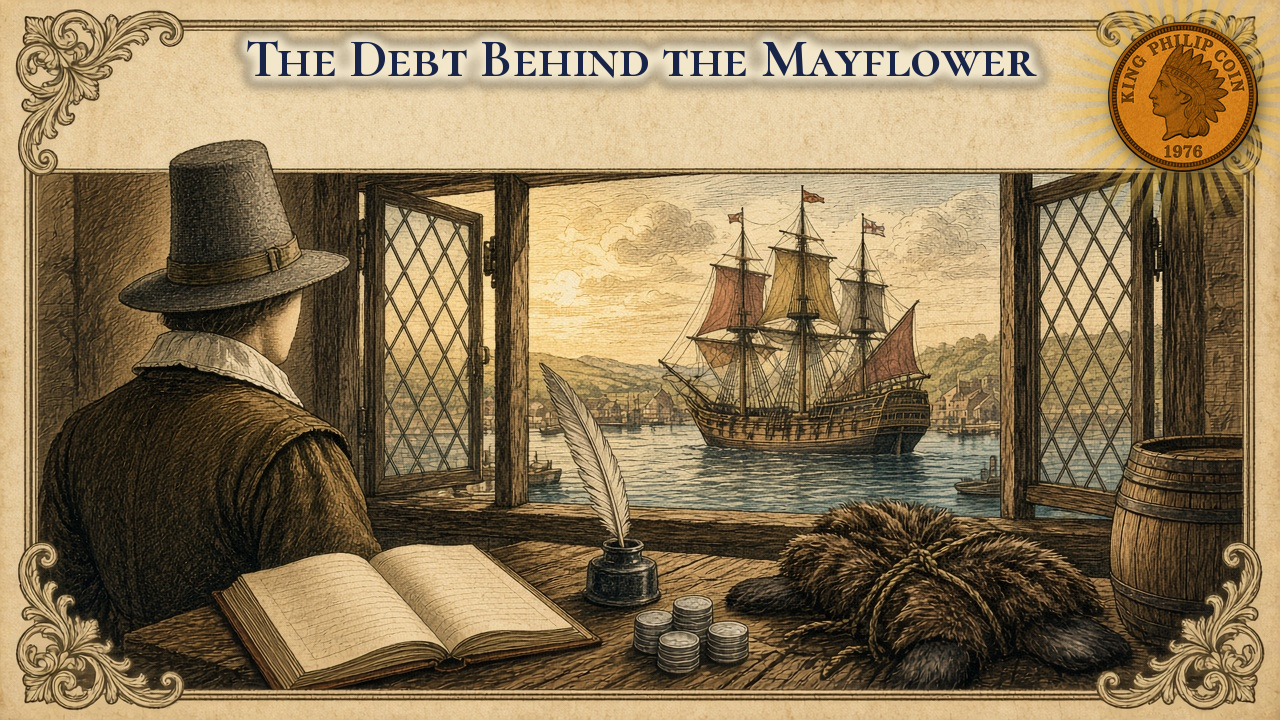
A congregation that couldn’t pay its own way
The Pilgrims’ congregation had been living as exiles in Leiden, Holland. Their longtime governor and historian, William Bradford, wrote that “the 12 years of truce were now out” between the Dutch and Spain, and there was “nothing but beating of drums, and preparing for war.” Bradford, Of Plimoth Plantation, Colonial Society of Massachusetts edition
They were working people with thin savings. An ocean crossing and a colony cost more than they had. So they did what folks still do. They found investors.
A London ironmonger named Thomas Weston organized a group of merchants who became known as the Merchant Adventurers. PBS NewsHour puts their number at about 70. The legal paperwork was a patent from the Virginia Company of London, issued in February 1620 in the name of one investor, John Peirce. When the Mayflower ended up well outside Virginia’s bounds, the investors got a fresh patent in June 1621 from Sir Ferdinando Gorges and the Council for New England, again in Peirce’s name. Colonial Society of Massachusetts
The fine print
The terms were dated July 1, 1620, and Bradford copied all ten articles into his history. Bradford, 1620 conditions In plain English:
- Every person 16 and older going over counted as one share, rated at £10.
- Settlers and investors would hold everything in one joint stock for seven years.
- Every profit, from “trade, traffic, trucking, working, fishing,” stayed in the common stock until the split.
- At the end of seven years, the houses, lands, goods and chattels would be divided equally between the investors and the planters.
- In the meantime everybody ate, drank and dressed out of the common store.
That’s a company town with an ocean around it.
Two changes in that contract stuck in the Leiden folks’ throats. Under the terms they first agreed to, Bradford says, their houses and gardens would stay with the planters at the end, and they would have two days a week to work for their own families. Weston and some of the investors wanted both changed. The Pilgrims’ agent in London, Robert Cushman, gave in so the voyage wouldn’t fall apart, and Bradford says the change was kept quiet to avoid more delay. When the Leiden folks found out, the complaints came fast. Cushman wrote back that he was being accused of “making conditions fitter for thieves & bondslaves than honest men.”
Weston came down to Southampton to get the new terms confirmed before they sailed. The passengers said no. Bradford says Weston told them they “must then look to stand on their own legs,” went home angry, and wouldn’t put up a penny of the roughly £100 they still owed to get out of port. So they sold off some 3 or 4 score firkins of butter to clear the harbor. Bradford, ch. 7
Here’s the working-guy translation. Their own man had already agreed to give away half of the houses they’d build with their own hands, and their two days a week. They sailed anyway, short on butter and long on faith, and they argued about the paper later.
The bill comes due in year one
Nearly half the colonists died that first winter. PBS NewsHour When the Mayflower sailed home in the spring of 1621, she went back without a cargo for the investors.
Weston answered with a letter dated July 6, 1621. “That you sent no lading in the ship, is wonderful, and worthily distasted,” he wrote. Bradford, Anno 1621 “Wonderful” there means astonishing, not terrific. He also scolded them for “weakness of judgment” and promised that if they loaded the next ship, “I will never quit the business.” PBS NewsHour, excerpting Ruth A. McIntyre
That fall came the harvest feast we now call the first Thanksgiving. Edward Winslow wrote that Massasoit came “with some ninety men, whom for three days we entertained and feasted.” Pilgrim Hall Museum
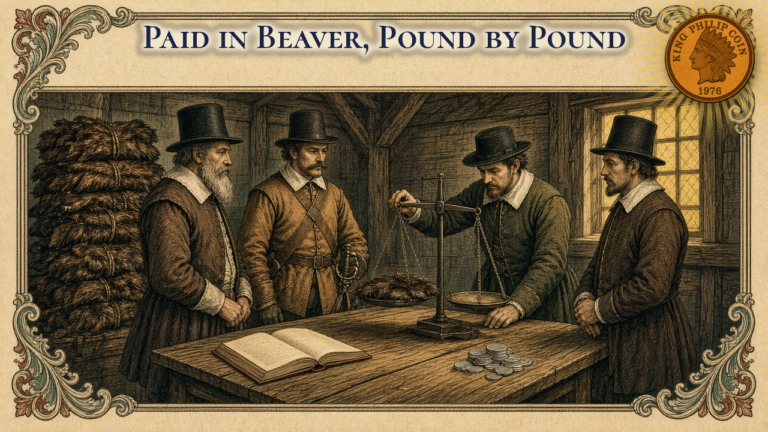
In November 1621 the next ship, the Fortune, showed up with Cushman and about 35 new settlers. Bradford wrote that there was “not so much as a bisquit cake or any other victuals for them.” Cushman also brought the investors’ demand that the colonists sign the 1620 conditions, and this time they did. The colony still loaded her for the trip home with clapboard and two hogsheads of beaver and otter skins, a cargo Bradford valued at “near £500.” A French privateer took the Fortune on the way home and seized the cargo. Pilgrim Hall Museum
The man who promised he’d never quit
Remember Weston’s promise? Bradford’s verdict: “all proved but wind, for he was the first, and only man that forsook them.” By 1622, letters from London reported that Weston had broken with the company and sold out his share. He sent over men of his own that year, and Bradford wrote they might have starved if Plymouth hadn’t helped feed them. Bradford, Anno 1622
Interest that would make a pawnshop blush
The money kept getting more expensive. In the mid-1620s, when the remaining investors sent goods over, they put 40 percent on top “for profit and adventure,” then another 30 percent for the risk of getting paid on the return trip, “which was in all 70 per cent.” In 1625 Captain Myles Standish went to London and, with much ado, borrowed £150 at 50 percent. Bradford, Anno 1625
The bad luck didn’t let up either. That same year a small ship carrying some 800 pounds of the colony’s beaver was taken by what Bradford called a “Turks’ man of war” in the English Channel, almost within sight of Plymouth, England. She was carried to Salé on the coast of Morocco. The master and crew were made slaves, and many of the beaver skins were sold for 4 pence apiece. Bradford, Anno 1625
Years of trapping, trading and hauling . . . gone for pocket change in a pirate port.
How it shook out
Pilgrim Hall Museum sums it up plainly. The debt “quickly became much larger” and was renegotiated in 1626. The investors may have put in as much as £7,000, the colonists eventually repaid £1,800, and “Plymouth Colony was not a success for the investors.” Pilgrim Hall Museum How a handful of Plymouth men put that £1,800 on their own backs, and what it cost them, is Wednesday’s story.
What I take from it
The Pilgrims weren’t fools. They were short on capital and long on conviction, and they borrowed against their own labor to get where they believed God wanted them. The terms were set by men who weren’t on the boat. When the ships were lost, the debt didn’t sink with them.
A storm can sink a ship, but it has never once sunk a promissory note.
I wont pretend there’s a straight line from a 1620 beaver contract to your household budget. The principle travels, though. When somebody else holds the paper, somebody else sets the terms. Whatever you can own outright, free and clear, is one less thing another man gets to decide for you. That goes for a paid-off truck, a paid-off house, or a few honest coins in your own hand. None of it is risk-free. All of it is yours.
So this Thanksgiving, when you say grace, maybe say a word for the folks who ate that first harvest still owing on the boat ride. They were thankful anyway. that’s worth something.
If you’ve got old coins, an inherited collection, or just a question about what something’s worth, come see me at King Philip Coin, 6821 Southpoint Dr N #228, Jacksonville, FL 32216. Call (904) 580-6543 or visit https://kingphilipcoin.com. Monday through Saturday, 12:30 to 5:00. Appointments preferred, walk-ins welcome. Free verbal appraisals, no obligation, coins examined in hand.
Happy Thanksgiving from my family to yours.
This is not investment advice . . . think for yourself.