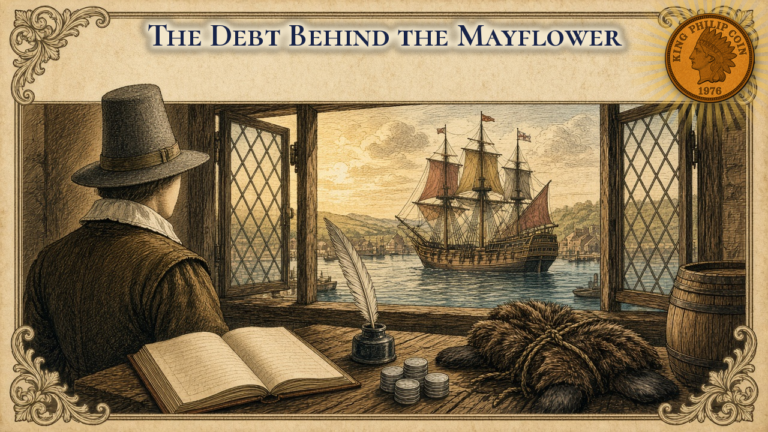
Yesterday I told you the Pilgrims came over on borrowed money. Today’s question is simpler, and it’s one a coin man can’t leave alone. Once they got here, what did they use for money?
You’d guess English shillings. You’d be mostly wrong. The Federal Reserve Bank of Boston puts it plainly: the first New England colonists “brought very little precious metal with them,” and money “was almost always in short supply.” They bartered. They paid in corn, in beaver, and, after a few years, in seashell beads. And the silver coin everybody in the Americas wanted wasn’t English at all. It was Spanish.
Spain’s shadow over the whole story
It’s hard to overstate how big Spain loomed over these people. Thirty-two years before the Mayflower, in 1588, Philip II of Spain sent the Armada to support an invasion of England. Royal Museums Greenwich England beat it back, but Spain was still the superpower of the age.
The Pilgrims had spent years in Leiden, a Dutch city that had survived a long Spanish siege in 1574. When Bradford explains why they left, Spain is right there: the twelve-year truce between the Dutch and Spain was running out, and “the Spaniard might prove as cruel, as the savages of America.” Bradford, Of Plimoth Plantation
They even talked about settling in Guiana, in South America, and turned it down. Bradford’s reason will catch the ear of anybody in Jacksonville: “the Jealous Spaniard would never suffer them long; but would displant, or overthrow them. As he did the French in Florida.” Bradford, ch. 5
The French in Florida were our neighbors
“The French in Florida” means Fort Caroline, the French Huguenot colony founded on June 30, 1564, on what we call the St. Johns River. The National Park Service lays out what happened next. On September 8, 1565, Pedro Menéndez de Avilés established St. Augustine. On September 20 the Spanish captured Fort Caroline. Two massacres of French prisoners followed. More than fifty years later, a congregation in Holland was still using that story as a warning.
Nobody has ever found the exact spot where the fort stood. Fort Caroline National Memorial, on Fort Caroline Road in Jacksonville, sits near where historians believe it was.
A Thanksgiving before Plymouth
St. Augustine has its own claim on this holiday, and since it’s just down the road from our shop, you’ll forgive me for bringing it up. According to the National Park Service, when Menéndez came ashore on September 8, 1565, his people celebrated a Mass of Thanksgiving, and then he laid out a meal and invited the native Seloy people. It was likely cocido, a stew of salted pork and garbanzo beans, with hard sea biscuits and red wine. That was 56 years before Plymouth.
Some historians argue that makes it the real first Thanksgiving. University of Florida historian Michael Gannon called it “the first community act of religion and thanksgiving in the first permanent settlement in the land.” Florida Museum of Natural History The Park Service is fair about it, too. St. Augustine’s thanksgiving came first, but it “did not become the origin of a national annual tradition.” Plymouth’s did. i’m happy to give thanks for both.
The interpreter who had been to Spain
Here’s a Spanish thread most of us never heard in school. Tisquantum, the man the Pilgrims called Squanto, had been kidnapped from Patuxet, the very spot where Plymouth was built, in 1614. Captain Thomas Hunt took a group of Wampanoag men and boys and sold them as slaves in Spain. Pilgrim Hall Museum Researchers have since found a deed in the provincial archive in Málaga, dated October 22, 1614, recording Hunt’s transfer of more than 25 captives. Plimoth Patuxet Museums
Freed with the help of go-betweens, he made his way to England, learned English, and came home in 1619 to find nearly everyone in his village dead from disease. He became the Pilgrims’ guide and interpreter. Bradford called him “a special instrument sent of God for their good beyond their expectation.” Bradford also wrote that none of them “ever saw a beaver skin till they came here, and were Informed by Squanto.” Pilgrim Hall Museum The fur trade that would eventually pay their debt got its first lessons from a man who had survived a slave market in Spain.
The piece of eight
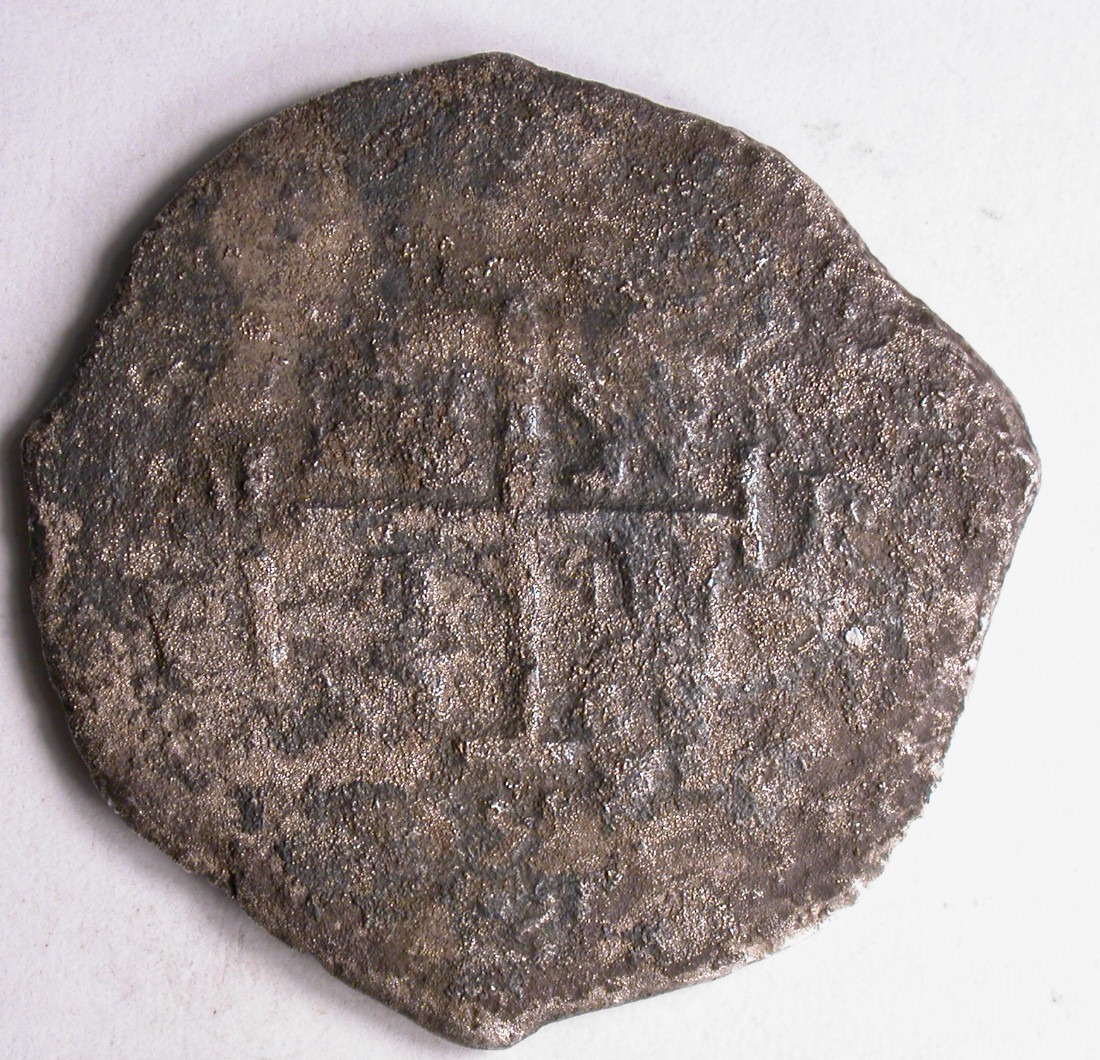
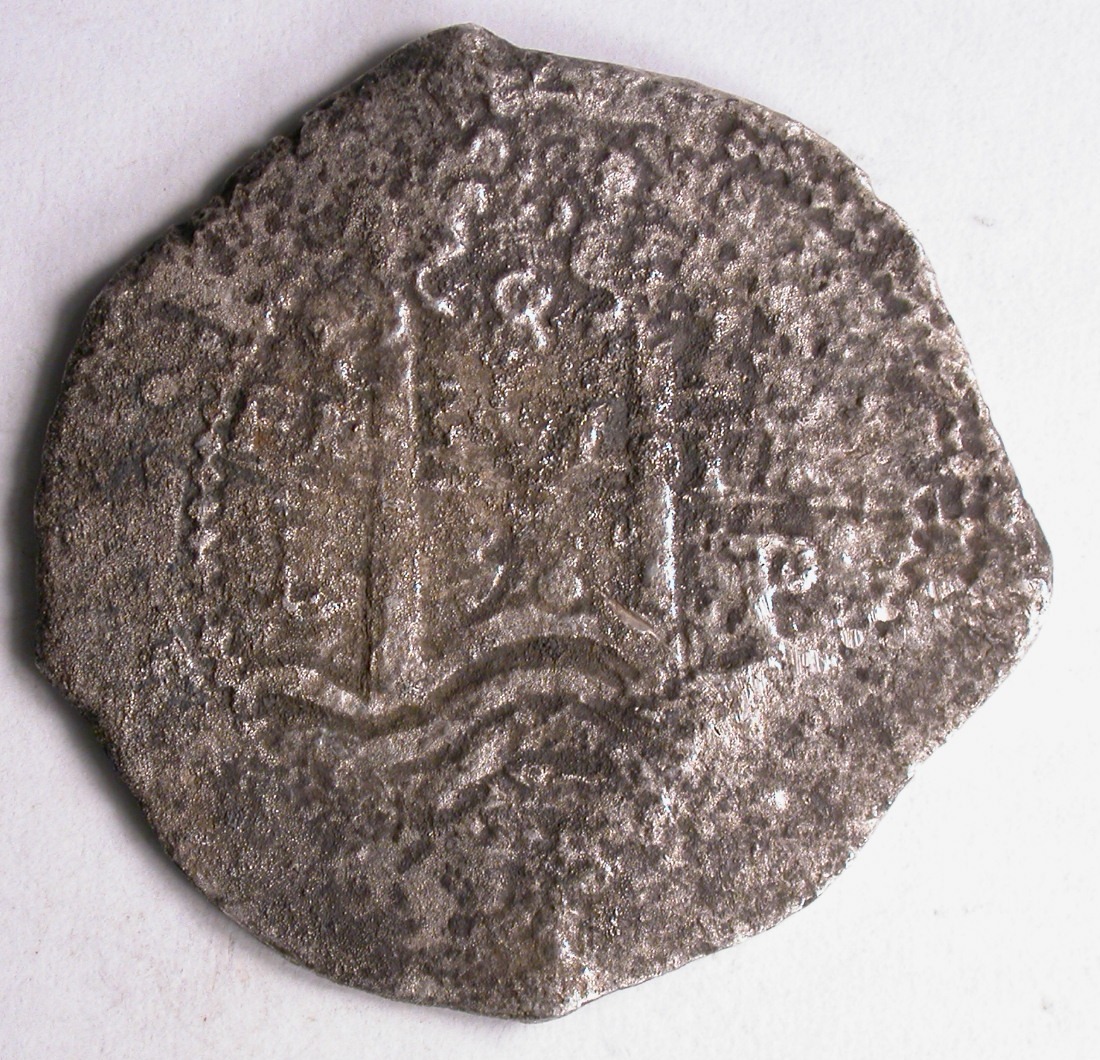
Now the coin. Spain’s empire sat on silver. The mountain of Potosí, in what is now Bolivia, was regarded in the 1500s as “the world’s largest industrial complex,” according to UNESCO. The big silver coin struck from Spanish American silver at Mexico City, Lima and Potosí was the eight-real piece, the piece of eight. University of London Press
Most of the early ones were “cobs.” The silver was cut by hand to the right weight and hammered between two dies, so no two are quite the same shape. Portable Antiquities Scheme The Smithsonian notes that colonists cut the coin into pieces to make small change, and that these coins were so widely used across the Americas, Europe, Asia and Africa “that they are considered to be the world’s first global currency.” Smithsonian National Museum of American History The coin was worth eight reales, and each real came to be called a “bit.” Two bits, a quarter dollar. Boston Fed
From 1556 to 1665 the King of Spain was always a Philip: Philip II, Philip III and Philip IV. Philip III was on the throne when the Mayflower sailed. Now, full disclosure: our shop’s name actually comes from a different King Philip. That was Metacom, the Wampanoag leader the English called King Philip. He was a son of Massasoit, the same man who came to that 1621 harvest feast. Britannica But down here in old Spanish Florida, it’s hard not to notice the other ones.
Plymouth’s money: corn, beaver and shells
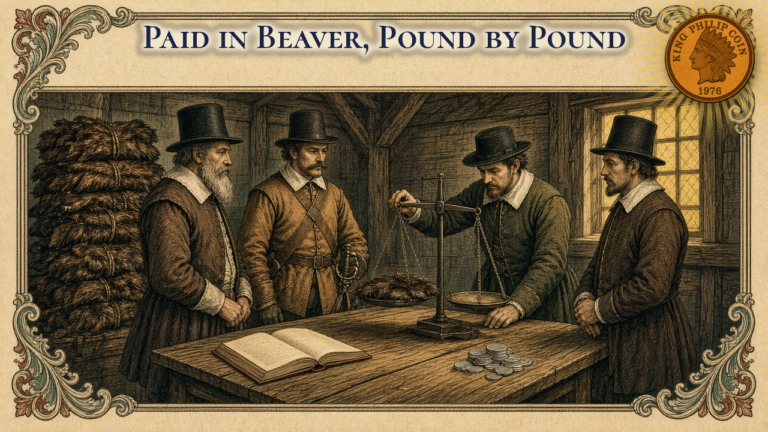
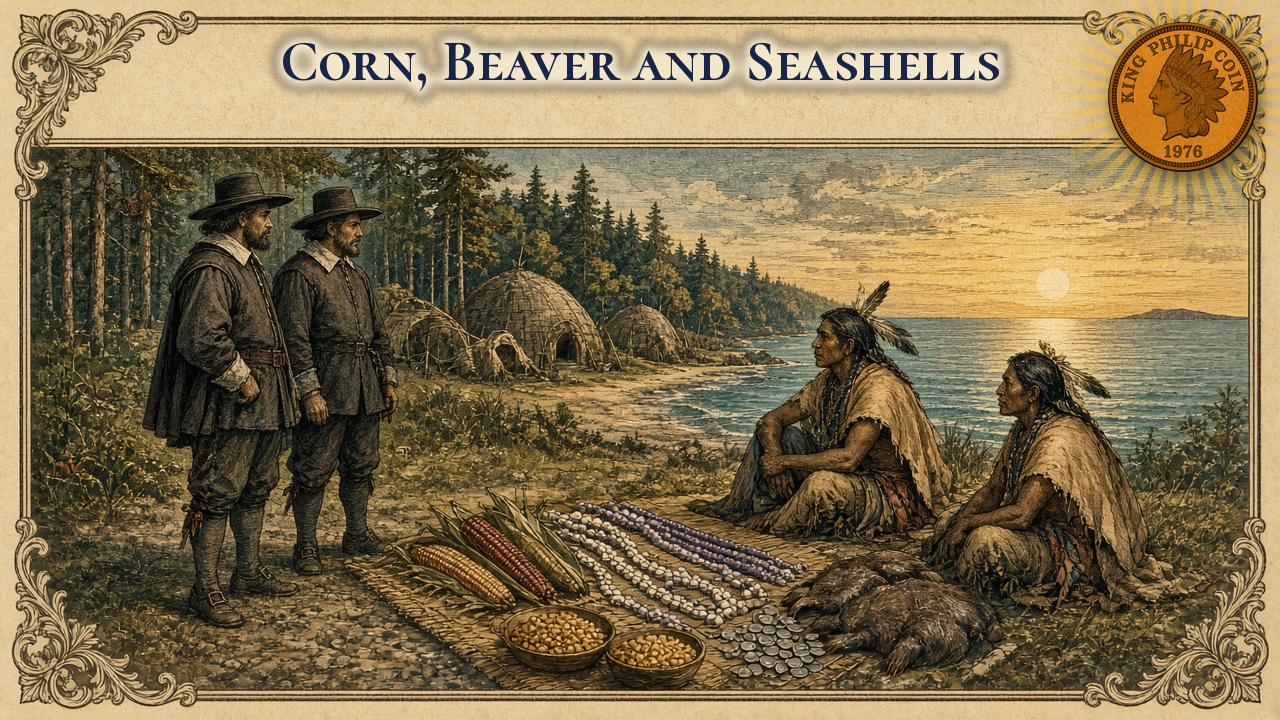
Plymouth itself ran on what it could grow, trap and trade. When a group of colonists took over the colony’s debts in 1627 (that’s tomorrow’s story), the deal was written in corn. Every purchaser owed them “3 bushels of corn, or 6 lbs. of Tobacco” a year, and the shoes and stockings they brought over would be “sold unto them for corn at 6s per bushel.” Bradford, Anno 1627 Corn was the cash. Beaver was the export that paid the bills in London.
Then came wampum, beads made from shell. In the late 1620s, Bradford says, they bought about £50 worth from the Dutch, who told them how well it sold at their trading fort upriver. It sat for two years before anybody inland would take it, “and afterwards they could scarce ever get enough.” Bradford, Anno 1628 Massachusetts made wampum legal tender in 1637. Poor shells and dyed beads cut its value, and by 1661 it was no longer legal tender. Boston Fed
What gets me is that Bradford saw it coming. Writing about wampum, he said: “It may prove a drug in time.” He didn’t mean medicine. A drug in that sense is a commodity nobody wants, the way we still say “a drug on the market.” Merriam-Webster Money anybody can make more of tends to end up that way . . . sooner or later. Silver from a mountain on the other side of the world was harder to fake with a pot of dye.
How the Spanish dollar became our dollar
The piece of eight outlasted the colonies. When Congress set up the Mint in 1792, it defined the new United States dollar as “of the value of a Spanish milled dollar as the same is now current.” Coinage Act of 1792, U.S. Statutes at Large The Spanish coin stayed legal tender here until 1857. Boston Fed
So the dollar in your wallet has a Spanish grandfather, and he was made of silver.
About that rock
You can’t tell this story without the rock. Plymouth Rock is real, and you can visit it, but here’s the honest version. The rock as the landing place is a tradition, and that tradition dates from 1741. Neither of the two accounts the Pilgrims themselves wrote, Bradford’s history and the 1622 book called Mourt’s Relation, mentions a rock at the landing. The first record of a “Grat Rock” on the waterfront shows up in town records in 1715/16. In 1741, when a wharf was going to be built over it, a church elder in his nineties named Thomas Faunce, whose father had come over in 1623, pointed out the rock as the landing place, a tradition he said came down from his father. Pilgrim Hall Museum, Smithsonian Magazine
So it’s a tradition, carried by memory for about 120 years, not a fact anybody wrote down at the time. I treat it the way I treat a coin with a great story and no paperwork. I enjoy the story. I just dont pay extra for it.
What I take from it
The Pilgrims didn’t get to choose their money they used what was scarce, real and hard to counterfeit when they could get it, and whatever they could eat or trade when they couldn’t. Silver did the heavy lifting on this continent for a couple hundred years. It still goes up and down in price, it needs safe storage, and there’s a spread when you buy and sell. But it doesn’t need anybody’s permission to be worth something.
If you’ve got old silver, foreign coins, or a family piece you’ve always wondered about, come see me at King Philip Coin, 6821 Southpoint Dr N #228, Jacksonville, FL 32216. Call (904) 580-6543 or visit https://kingphilipcoin.com. Monday through Saturday, 12:30 to 5:00. Appointments preferred, walk-ins welcome. Free verbal appraisals, no obligation, coins examined in hand. If you’re thinking about silver for your own family, start at our bullion page.
Happy Thanksgiving from my family to yours.
This is not investment advice . . . think for yourself.